At Africa’s Green Economy Summit in Cape Town this year, a senior Development Bank executive said something I haven’t been able to forget: “Africa’s natural environment is an unpaid worker in the global economy.”
He wasn’t speaking metaphorically. He was naming a structural reality with financial precision: who generates wealth, who captures it, and who’s been quietly subsidising everyone else’s survival without ever appearing on the balance sheet.
I’m not an environmentalist. I don’t speak the language of carbon credits or nature bonds. I do however speak the language of value: what produces it, and who pays for it without receiving acknowledgement or return. And that language, it turns out, is exactly what this conversation is about.
How Africa’s Green Economy Is Delivering Uncompensated Labour
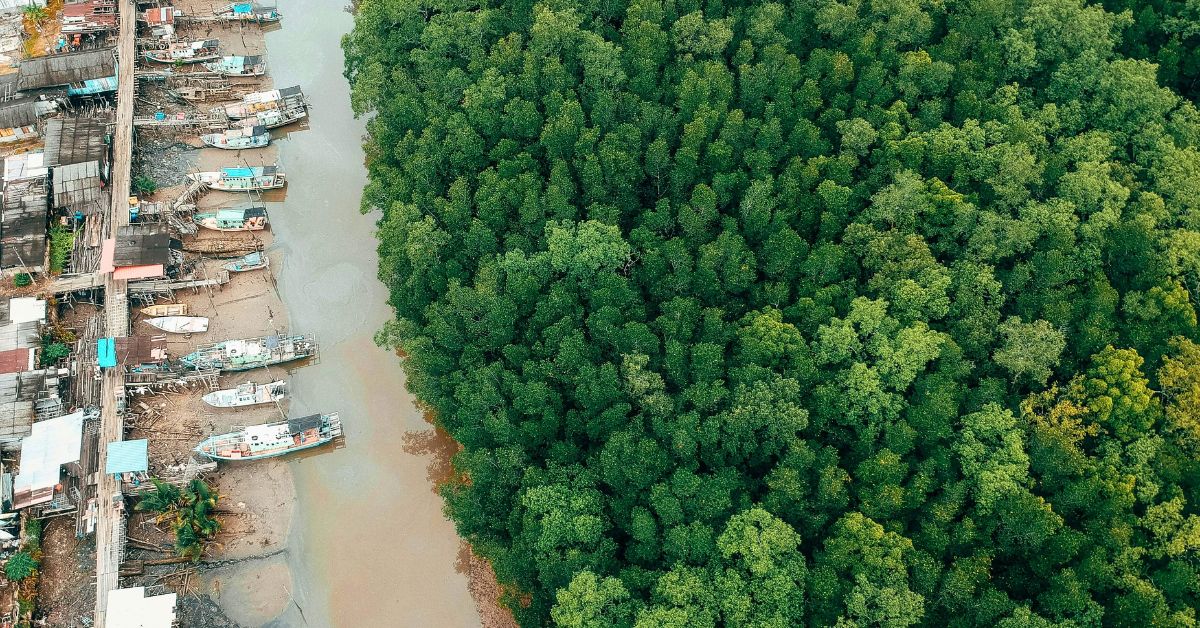
Consider the Zambezi Delta’s mangroves. These coastal trees stabilise shorelines, filter water, and sequester carbon at rates three to five times higher than most land-based forests. And when Cyclone Idai hit Mozambique in 2019, mangrove systems helped buffer the impact on shoreline communities.
Or the Congo Basin, which historically absorbed approximately 1.5 billion tons of carbon dioxide annually (though its capacity has since halved to about 600 million tons, equivalent to Germany’s total emissions). It’s providing one of the most consequential ecological services on earth, supporting over 75 million people and regulating rainfall patterns across the continent.
The World Economic Forum estimates that more than half of global GDP – $44 trillion – depends on functioning natural systems of precisely this kind.
But the mangroves have never been paid. And neither, in any meaningful structural sense, has the continent that holds them.
Old Extraction, New Language
This is not a new pattern. Every major system of economic expansion in the modern era has depended on a category of value it refused to price. Enslaved labour built the foundational wealth of the Atlantic economy and was never compensated. Colonial extraction transferred mineral wealth and ecological resources from the Global South to the Global North at terms set entirely by the extractor. The industrial economy was built on commons (shared land, water, forests) that were enclosed, privatised, and sold back to the communities they were taken from.
The foundational move, in each case, is identical: identify something that produces value, define it as ambient, natural, or simply available, and build a profitable system on the premise that it doesn’t need to be paid for.
In the current economy, we can take the example of care work – the labour of raising children, sustaining households, caring for the elderly and ill. The ILO estimates it’s worth between $10 and $13 trillion annually, and in some economies, can contribute more than the manufacturing, commerce or transportation sectors. Yet it doesn’t appear in any nation’s GDP. Women perform the majority of it globally; in Africa, approximately 75 percent.
So a continent whose forests are doing uncompensated planetary labour is also a continent whose women are doing uncompensated civilisational labour. Same architecture. Different arena.
The green economy didn’t invent this logic. But it is, right now, deciding whether to inherit it.
Which brings us to the question of how the rules get written.
Africa’s Green Economy Is Generating Wealth – But Who Is It Reaching?
To be clear, there’s significant progress being made in how African ecological value is being recognised and financed. African carbon credits reached around $1.2-1.5 billion in value in 2024. Debt-for-nature swaps are emerging, as in Gabon’s pioneering 2023 deal. These are real developments. However, studies show that often only 10-20% or less of proceeds effectively reach the communities whose land and labour make those credits possible.
Why?
The legal standard for community participation is called Free, Prior and Informed Consent. It stipulates that no project should proceed on a community’s land without genuine voluntary agreement, secured before decisions are made. But in practice, communities are typically consulted after a project’s fundamental architecture has already been set, because genuine early participation is expensive, and expensive things require funding that only flows once a project is sufficiently de-risked for institutional investors. This means that often, by the time community consent is sought, two of the conditions that matter most – that it be free, and prior – have already been violated.
The system produces the exclusion, then rationalises it.
But here’s what makes this moment different: the frameworks governing the green economy are being written now. The standard-setting bodies, the validation methodologies, the definitions of what counts as legitimate and what gets excluded – these decisions will determine the distribution of hundreds of billions of dollars over the next several decades. And Africa is increasingly in those decision-making rooms, not as a recipient of solutions but as an architect of systems.
That’s the most politically significant development in this space.
The Window Is Open. Africa Is In The Room
The green economy’s window of standard-setting is open now, but it won’t stay open indefinitely. The question is whether those who understand the pattern most intimately, who’ve lived the logic of ambient, uncompensated value from every possible angle, will be present and powerful enough to interrupt it before the architecture is set.
If the summit in Cape Town is anything to go by, they are. And they will be.
And that’s a shift that should feel compelling to anyone who’s ever produced value that a larger system consumed without acknowledgment or return.
Which is most of us. Which is, in fact, the point.